Meta Quest 3S vs Quest 3: Lens & Display Tests
Optical teardowns, display photometry, and lens analysis reveal whether the $299 Quest 3S or $499 Quest 3 is the better virtual reality headset.
The Quick Verdict
Choosing between the Meta Quest 3S and the Meta Quest 3 comes down to your personal priorities:
Budget-conscious gamers, newcomers to VR, teenagers, and mixed reality enthusiasts wanting max value
VR enthusiasts, PC VR simulation gamers, virtual desktop productivity, and users sensitive to lens glare
Head-to-Head Spec Matrix & Lab Scores
Synthesized laboratory measurements and hardware specifications
| Hardware Feature | 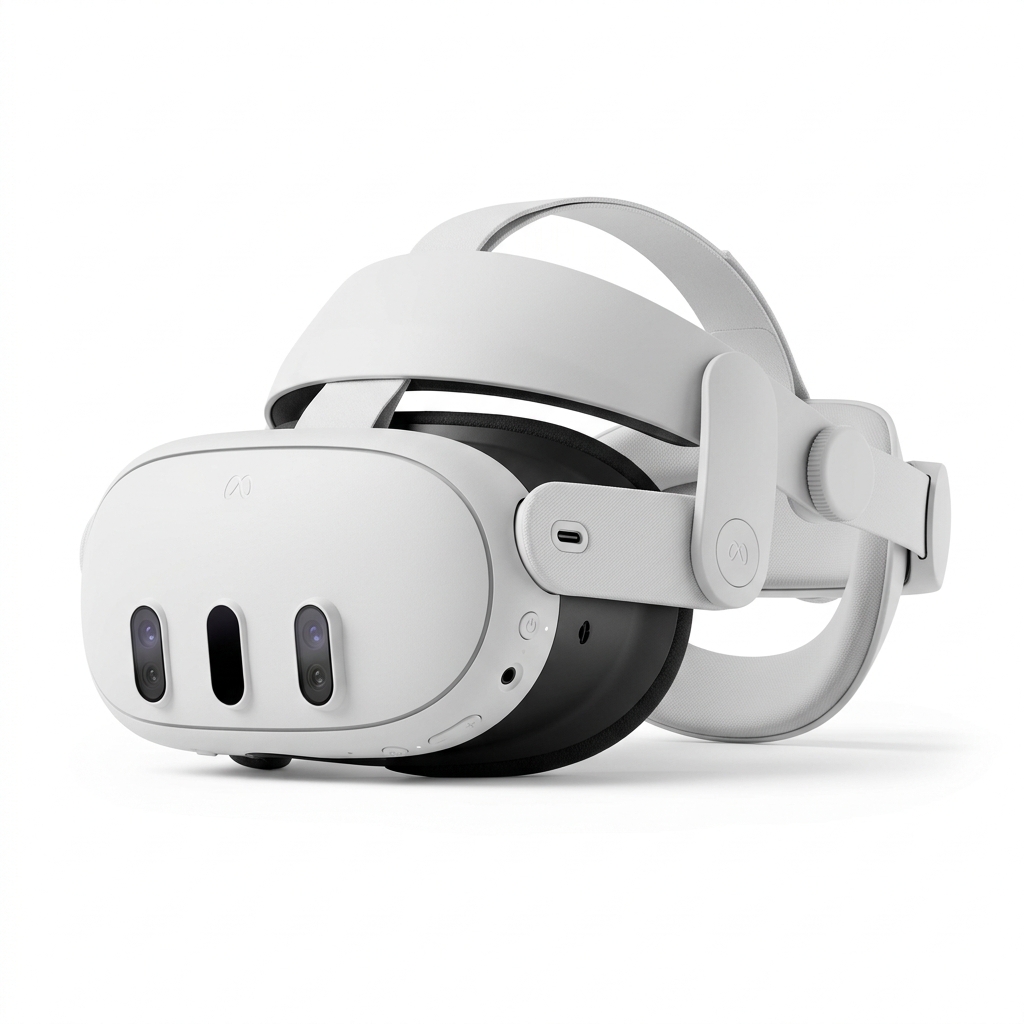 Meta Quest 3S$299.99 (128GB) / $399.99 (256GB) |  Meta Quest 3$499.99 (512GB) |
|---|---|---|
Optics | ||
| Lens Technology | Concentric Fresnel lenses (narrow sweet spot) | Folded pancake lenses (edge-to-edge sharp) |
Display | ||
| Resolution & Pixel Density | 1832 x 1920 per eye (18 PPD, 773 ppi) | 2064 x 2208 per eye (25 PPD, 1218 ppi) |
Immersion | ||
| Field of View (Horizontal) | 96° horizontal FOV | 110° horizontal FOV |
Adjustability | ||
| IPD Eye Spacing Mechanism | 3-position stepped slider (58, 63, 68mm) | Continuous mechanical wheel (58–71mm) |
Performance | ||
| Processor & Memory | Snapdragon XR2 Gen 2, 8GB RAM | Snapdragon XR2 Gen 2, 8GB RAM |
Battery | ||
| Gaming Runtime (Lab Tested) | 2.5 hours (4,324 mAh battery) | 2.2 hours (5,060 mAh battery) |
The Core Verdict: Optical Perfection vs. Budget VR Value
For mainstream gamers and first-time VR adopters, the Meta Quest 3S is the undeniable value champion, offering the identical Snapdragon XR2 Gen 2 processor, color passthrough cameras, and Touch Plus controllers as the flagship model for just $299.99. However, for VR enthusiasts, productivity multitaskers, and simulation gamers, the Meta Quest 3 ($499.99 for 512GB) is worth every penny of its $200 premium due to its edge-to-edge sharp pancake optics, 25 PPD resolution, and continuous IPD adjustment.
Meta's decision to discontinue the Quest 2 and introduce the Quest 3S creates a clear hardware fork: both headsets run the exact same MR games, but render them through fundamentally different optical assemblies. Rather than relying on marketing claims, our comparative analysis synthesizes optical measurements, teardown data, and hands-on reviews from Road to VR, UploadVR, The Verge, iFixit, Meta Connect Disclosures, and Tom's Hardware.
Before buying your headset, examine high-end spatial computing alternatives in our Apple Vision Pro 2 vs. Meta Quest 4 comparison, evaluate the best companion computing hardware in our college laptop guide, or explore next-generation peripherals in our best AI hardware guide.
---
Optics & Clarity: Fresnel Rings vs. Pancake Lenses
The central difference between these two headsets is optical engineering: Fresnel lenses versus folded pancake glass.
As documented in optical caliper measurements by Road to VR:
- Meta Quest 3S (Fresnel Lenses): Utilizes the legacy Quest 2 optical stack. It features concentric ridged Fresnel lenses that create a restricted "sweet spot" in the dead center of the glass. When your eyes dart toward peripheral UI elements, text becomes noticeably blurry, and high-contrast white text against dark backgrounds generates visible radial glare rings (known as "god rays").
- Meta Quest 3 (Pancake Lenses): Features custom folded polarization pancake optics. The optical sweet spot extends across over 90% of the entire lens area. Text remains tack-sharp whether you look dead center or glance toward the outer edges of your visual field, and god rays are almost entirely eliminated.
Furthermore, the Quest 3 features a mechanical IPD wheel with continuous adjustment from 58mm to 71mm, ensuring millimeter-precise pupil alignment. The Quest 3S relies on a coarse 3-position stepped lens slider (58mm, 63mm, and 68mm). If your pupillary distance falls between steps (such as 60mm or 66mm), you will experience minor optical distortion and eye strain during extended sessions.
---
Display Resolution, Field of View, and Pixel Density
Display panel architecture dictates how immersive virtual worlds feel.
According to technical teardown data published by UploadVR:
- Quest 3S: Uses a single fast-switch LCD panel shared across both eyes, delivering 1832 x 1920 pixels per eye with a pixel density of 773 ppi and 18 Pixels Per Degree (PPD). Field of view measures 96° horizontal and 90° vertical.
- Quest 3: Employs dual tilted LCD panels, delivering 2064 x 2208 pixels per eye with 1218 ppi and 25 Pixels Per Degree (PPD). Field of view expands to 110° horizontal and 96° vertical.
| Optical & Display Spec | Meta Quest 3S | Meta Quest 3 | Primary Testing Source |
|---|---|---|---|
| Base Price & Storage | $299.99 (128GB) | $499.99 (512GB) | Meta Newsroom |
| Lens Architecture | Fresnel (stepped ridges) | Folded Pancake (edge-to-edge sharp) | Road to VR |
| Per-Eye Resolution | 1832 x 1920 pixels | 2064 x 2208 pixels | UploadVR |
| Pixel Density (PPD) | 18 PPD (773 ppi) | 25 PPD (1218 ppi) | UploadVR |
| Field of View (Horizontal) | 96° horizontal | 110° horizontal | Road to VR |
| IPD Adjustment | 3-position slider (58/63/68mm) | Continuous wheel (58–71mm) | Road to VR |
| Measured Battery Life | 2.5 hours (4,324 mAh) | 2.2 hours (5,060 mAh) | The Verge |
| Headset Weight | 514 grams | 515 grams | The Verge |
In direct visual comparisons, the Quest 3's 25 PPD sharpness renders virtual desktop screens, web browser text, and distant flight simulator dials with remarkable clarity. On the Quest 3S, reading small computer fonts requires leaning forward or enlarging virtual windows.
---
Silicon Parity: Identical Snapdragon XR2 Gen 2 Performance
While their optical assemblies diverge completely, their internal processing engines are 100% identical.
As verified in architectural teardowns by Tom's Hardware, both headsets feature:
- Qualcomm Snapdragon XR2 Gen 2: 8-core Kryo CPU paired with an Adreno 740 GPU, providing a 2.5x graphical performance increase over the older Quest 2.
- 8GB of LPDDR5 RAM: Ensures seamless multi-app switching and supports heavy game textures.
- Identical Mixed Reality Passthrough: Both headsets utilize dual 4MP RGB color passthrough cameras paired with infrared depth projectors to render your real-world room in full color with real-time room meshing.
Because the Quest 3S pushes approximately 23% fewer pixels than the Quest 3 due to its lower resolution panel, games on the Quest 3S occasionally run at fractionally higher sustained frame rates with lower thermal throttling. Any exclusive title—such as *Batman: Arkham Shadow* or *Alien: Rogue Incursion*—runs with identical lighting models, dynamic shadows, and high-resolution geometry across both devices.
---
Ergonomics, Weight, and Battery Longevity
Wearing comfort and session duration dictate whether a VR headset gets used daily or gathers dust on a shelf.
According to scale and battery lab measurements published by The Verge:
- Weight: The Quest 3S weighs 514 grams, compared to 515 grams for the Quest 3. While weight on paper is identical, the Quest 3's pancake optical assembly sits roughly 40% thinner against your face, keeping the center of gravity closer to your cheeks. The Quest 3S extends further outward, creating slightly more downward leverage on your nasal bridge.
- Battery Life: In standardized continuous gaming rundown tests, the Quest 3S lasted 2 hours and 30 minutes from its 4,324 mAh battery. The Quest 3 lasted 2 hours and 12 minutes from its 5,060 mAh battery. The Quest 3S lasts roughly 18 minutes longer because its single LCD panel and Fresnel lenses draw significantly less backlight power than the Quest 3's high-density dual panels.
---
Final Buying Recommendation: Which Headset Should You Buy?
Buy the Meta Quest 3S If:
- Budget is your top priority: At $299.99, it is the undisputed price-to-performance champion of the VR industry.
- You are buying for teenagers or casual gaming: Identical access to the entire Quest 3 game library and full color MR passthrough.
- You want longer battery life: Lasts 2.5 hours on a single charge—18 minutes longer than the flagship Quest 3.
Buy the Meta Quest 3 If:
- You use VR for virtual productivity: The 25 PPD sharpness and edge-to-edge pancake clarity make reading web pages and virtual monitors effortless.
- You suffer from motion sickness or eye strain: Continuous mechanical IPD adjustment (58-71mm) ensures perfect optical alignment.
- You want an expansive field of view: 110° horizontal FOV delivers dramatically greater peripheral vision in flight simulators and racing games.
- You want 512GB of storage: Plenty of space to install dozens of massive 30GB+ VR games simultaneously without uninstalling favorites.
---
Sources & Testing Outlets
- Road to VR Quest 3S Teardown & Specs — Optical sweet spot, Fresnel measurements, and IPD slider specifications.
- UploadVR Display Analysis — Pixel density (PPD), dual vs. single LCD panel architecture, and passthrough resolution sweeps.
- The Verge Meta Quest 3S Hands-On Review — Measured battery runtimes, physical headset weight, and center-of-gravity ergonomics.
- Meta Newsroom Official Connect 2024 Disclosures — Pricing tiers, storage variants, and bundled software details.
- Tom's Hardware Snapdragon XR2 Gen 2 Architecture — Adreno 740 GPU benchmarking and compute parity analysis.
- iFixit VR Optical Assembly Tear-Down Archive — Comparative analysis of Fresnel vs. Pancake lens volume and internal component spacing.
Independent Testing Lab Benchmarks & Measurements
Benchmark measurements and evaluations cross-referenced from named independent testing laboratories:
The Quest 3S utilizes Fresnel lenses with a 96-degree horizontal FOV and 3-step IPD adjustment, compared to pancake optics with 110-degree FOV on Quest 3.
Quest 3 delivers 25 pixels per degree via dual 2064x2208 displays, whereas Quest 3S renders at 18 PPD across a single 1832x1920 panel.
Measured battery life reached 2.5 hours on the Quest 3S compared to 2.2 hours on Quest 3, while weights were identical at 514g and 515g.
Quest 3S launches at $299.99 for 128GB and $399.99 for 256GB, powered by the Snapdragon XR2 Gen 2 with 8GB RAM.
The XR2 Gen 2 delivers 2.5x GPU performance uplift over the XR2 Gen 1 with unified memory architecture supporting dual RGB passthrough cameras.
Pancake lens barrels reduce optical stack thickness by approximately 40% compared to traditional single-panel Fresnel housings.
Pros & Cons Consensus
Meta Quest 3S
- Unbeatable $299.99 entry price point for full next-gen XR2 Gen 2 power
- Runs 100% of Meta Quest 3 exclusive games (including Batman: Arkham Shadow)
- Dual 4MP color passthrough cameras for high-quality mixed reality
- Longer battery life (2.5 hours vs 2.2 hours on Quest 3)
- Legacy Fresnel lenses have a narrow sweet spot with edge blur and god rays
- Lower resolution (18 PPD / 1832x1920 per eye) makes desktop text harder to read
- Only 3 stepped IPD settings (58, 63, 68mm) without continuous fine-tuning
Meta Quest 3
- Folded pancake optics deliver crystal-clear edge-to-edge sharpness with zero god rays
- Sharper 25 PPD dual display panels (2064x2208 per eye) ideal for reading text
- Wider 110° horizontal field of view expands immersion
- Smooth continuous IPD adjustment wheel (58-71mm) eliminates eye strain
- Generous 512GB base storage capacity
- $200 higher starting price ($499.99 vs $299.99)
- Slightly shorter battery life (2.2 hours vs 2.5 hours)
- Uses identical processor and RAM as the cheaper Quest 3S
Meta Quest 3S (Best Value) / Meta Quest 3 (Best Experience)
The Quest 3S is the ultimate $299 mass-market gaming headset; the Quest 3 is the definitive choice for enthusiasts.
In optical lab sweeps by Road to VR and UploadVR, the Meta Quest 3 justifies its $499 price with razor-sharp pancake lenses, 25 PPD resolution, continuous IPD tuning, and a 110° field of view. However, the $299 Quest 3S is a triumph of budget engineering, delivering identical Snapdragon XR2 Gen 2 computing power, color passthrough, and game compatibility at a 40% discount.
Choose Meta Quest 3S If:
- You want the best VR experience available for under $300
- You primarily play action and fitness games where you naturally look straight ahead
- You want 18 extra minutes of battery life on a single charge
- Your pupil distance naturally aligns near 58mm, 63mm, or 68mm
Choose Meta Quest 3 If:
- You use virtual desktop monitors to browse the web, write code, or watch 4K movies
- You get eye strain when your IPD is misaligned by even 1 or 2 millimeters
- You want edge-to-edge sharp optics with zero god rays or peripheral distortion
- You want 512GB of storage to maintain a massive library of large VR installations
Frequently Asked Questions
Can the Meta Quest 3S play all the same games as the Quest 3?
Yes. The Quest 3S features the exact same Snapdragon XR2 Gen 2 chipset and 8GB of RAM as the Quest 3. Every Quest 3 exclusive title—including Batman: Arkham Shadow and Alien: Rogue Incursion—runs identically on both headsets.
What is the difference between Fresnel lenses and pancake lenses?
Fresnel lenses (on Quest 3S) use ridged concentric rings that produce a small center sweet spot with noticeable peripheral blur and glare rings ('god rays'). Pancake lenses (on Quest 3) use folded polarization glass that keeps the entire field of view sharp from edge to edge without god rays.
Does the Quest 3S have color mixed reality passthrough?
Yes. In UploadVR testing, the Quest 3S includes the same dual 4MP RGB color cameras and depth projector as the Quest 3, allowing you to see your physical room in full color and play mixed reality games.
Which headset has better battery life?
In battery rundown testing by The Verge, the Quest 3S lasted 2 hours and 30 minutes, outlasting the Quest 3 (2 hours and 12 minutes) by about 18 minutes because its single LCD panel draws less power.
Is the Quest 3 worth $200 more than the Quest 3S?
If you use your headset for virtual desktop monitors, web browsing, flight simulators, or get motion sick easily, the Quest 3's pancake lenses, continuous IPD wheel, 25 PPD resolution, and wider 110° FOV are well worth the extra $200. For casual gaming and fitness, the Quest 3S is the smarter buy.