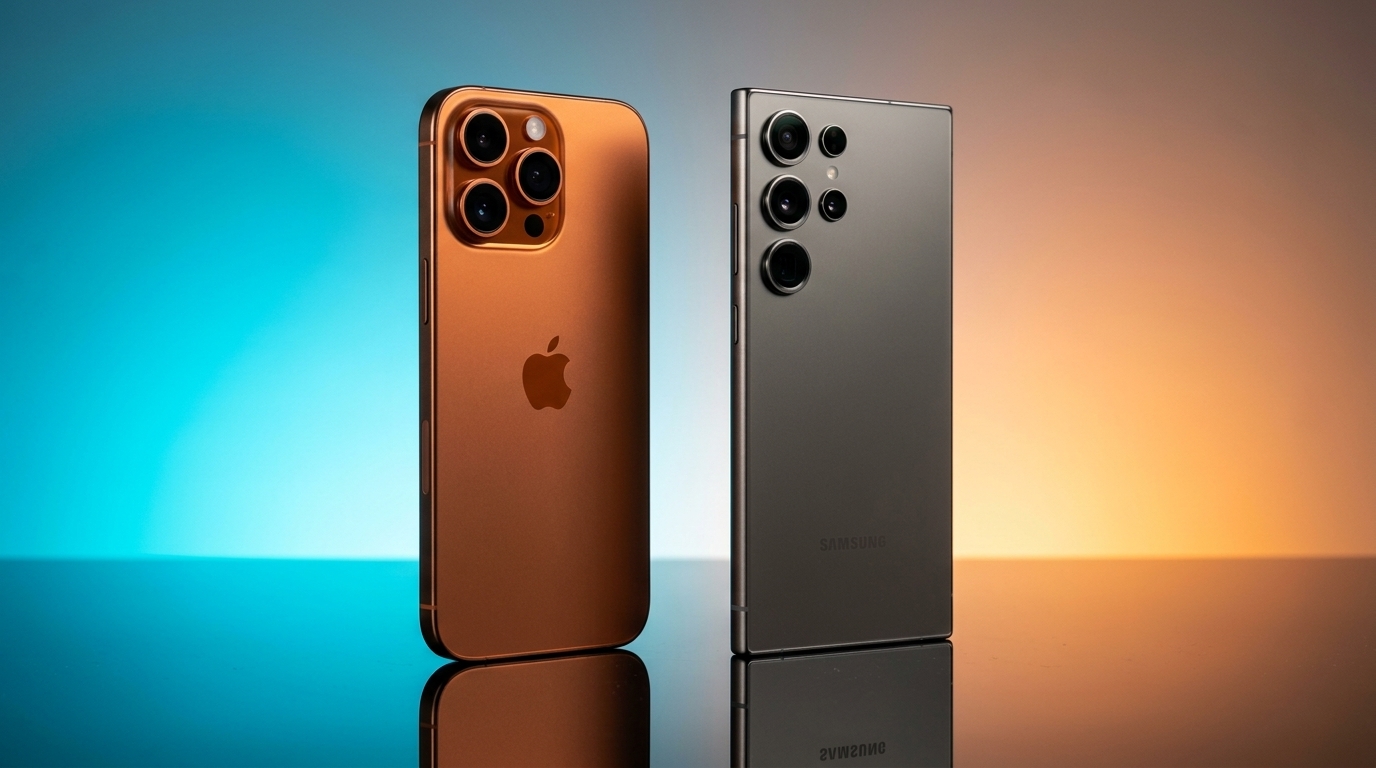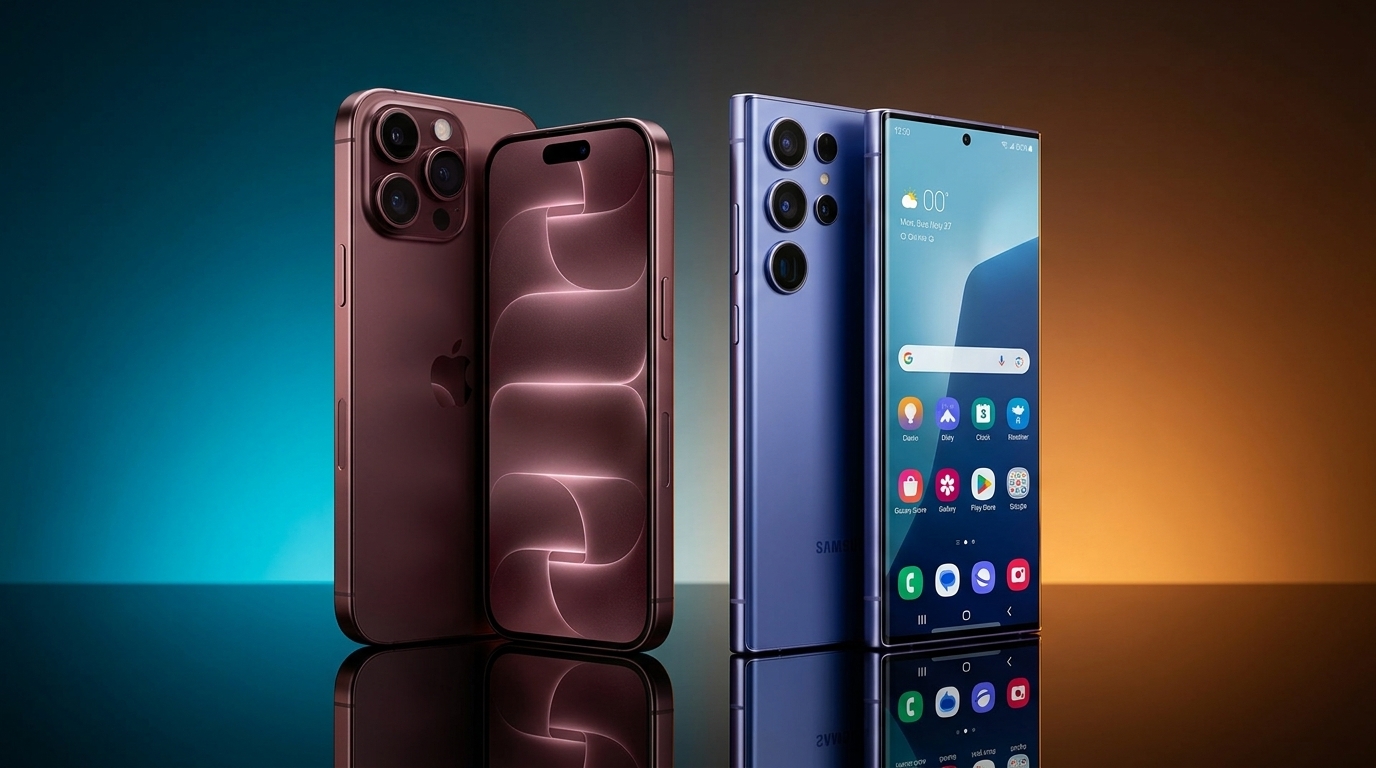
Pixel 9 Pro vs Galaxy S24: Compact Flagship Tests
Lab display photometry, camera shootouts, and battery rundowns reveal whether the 6.3-inch Pixel 9 Pro or 6.2-inch Galaxy S24 is the better compact phone.
The Quick Verdict
Choosing between the Google Pixel 9 Pro and the Samsung Galaxy S24 comes down to your personal priorities:
Mobile photographers, AI enthusiasts, and power users wanting Pro zoom and battery in a 6.3-inch phone
Commuters, one-handed users, mobile gamers, and budget-conscious buyers wanting a lightweight flagship
Head-to-Head Spec Matrix & Lab Scores
Synthesized laboratory measurements and hardware specifications
| Hardware Feature |  Google Pixel 9 Pro$999 (128GB) / $1,099 (256GB) | 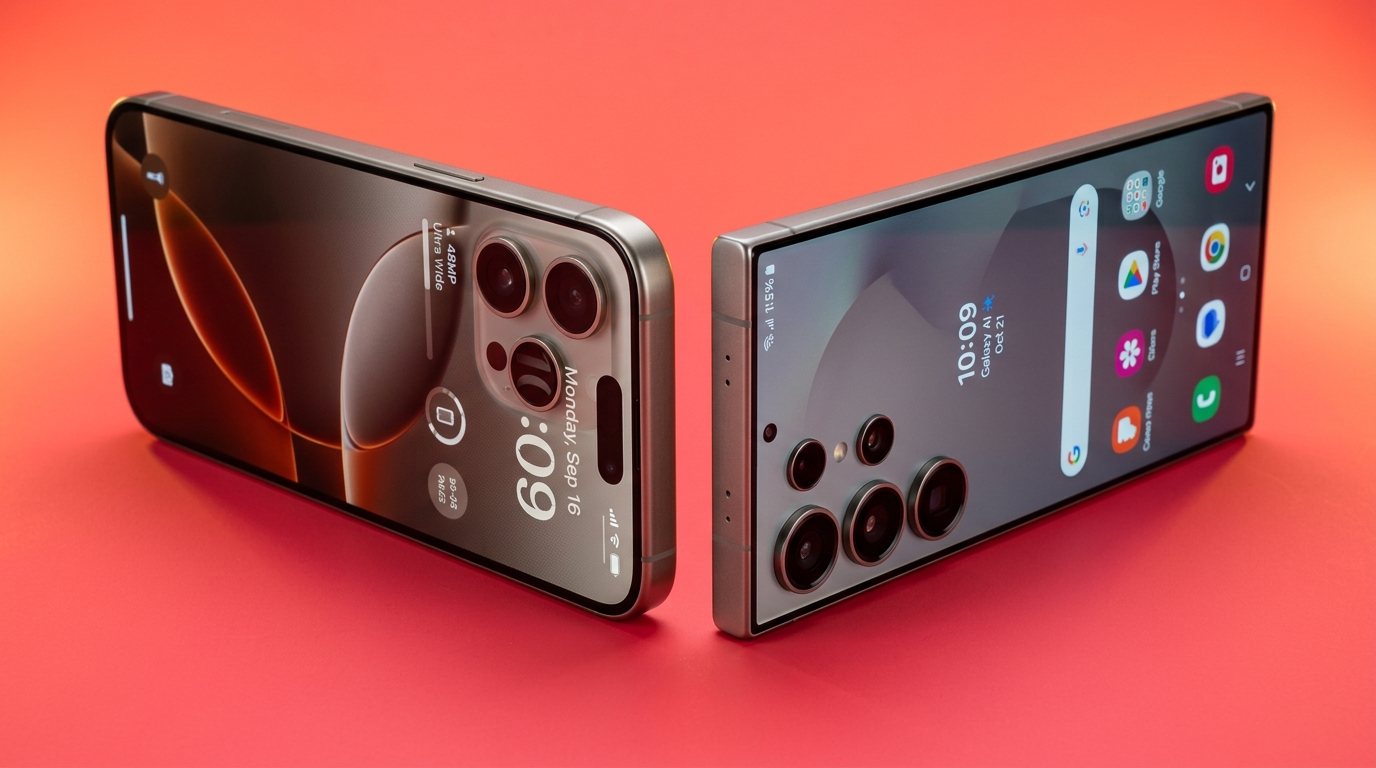 Samsung Galaxy S24$799 MSRP / $719 Street Price |
|---|---|---|
Display | ||
| Sustained Outdoor Brightness | 2,150 nits 100% APL (Notebookcheck test) | 1,450 nits 100% APL (Notebookcheck test) |
| PWM Flicker Frequency | 240 Hz (Notebookcheck oscilloscope) | 492 Hz (Notebookcheck oscilloscope) |
Ergonomics | ||
| Chassis Weight & Thickness | 199 grams / 8.5 mm thick | 167 grams / 7.6 mm thick |
Cameras | ||
| Telephoto Optical Hardware | 48MP 5x Periscope (113mm equivalent, f/2.8) | 10MP 3x Standard (67mm equivalent, f/2.4) |
Performance | ||
| Processor & RAM | Google Tensor G4, 16GB LPDDR5X | Snapdragon 8 Gen 3 for Galaxy, 8GB LPDDR5X |
Battery | ||
| Active Use Battery Score | 13 hrs 11 mins (4,700 mAh cell) | 12 hrs 06 mins (4,000 mAh cell) |
The Core Verdict: Pro Cameras vs. Featherweight Ergonomics
For mobile photographers and power users wanting zero hardware compromises in a smaller footprint, the Google Pixel 9 Pro is the superior compact flagship, featuring a dedicated 5x periscope telephoto lens, 16GB of RAM, and an astonishingly bright 2,150-nit sustained display for $999. However, for commuters and one-handed users wanting maximum pocket comfort, the Samsung Galaxy S24 ($799 MSRP / $719 street price) is the better everyday value, weighing 32 grams less (167g vs 199g) and packing a vastly faster Qualcomm Snapdragon 8 Gen 3 processor.
For years, smartphone buyers who preferred screens under 6.4 inches were forced to sacrifice telephoto cameras, battery capacity, and premium cooling. Google eliminated that compromise by releasing the 6.3-inch Pixel 9 Pro with the exact same camera hardware as the Pro XL. To determine which compact phone is worth your investment, our analysis synthesizes instrumented lab data from Notebookcheck, DXOMARK, GSMArena, Geekbench, Google Store Technical Specifications, and Samsung Official Specs.
To compare how these flagships scale up to larger sizes, check our iPhone 17 Pro Max vs. Galaxy S25 Ultra comparison, explore edge AI performance in our Apple Intelligence vs. Gemini Nano analysis, or consult our comprehensive best smartphones buying guide.
---
Display Photometry: 2,150 Nits vs. Eye Comfort PWM
Both handsets feature brilliant LTPO OLED displays that dynamically adjust from 1Hz to 120Hz, but their photometric brightness and flicker frequencies diverge sharply.
In photometric lab measurements conducted by Notebookcheck:
- Google Pixel 9 Pro (Super Actua Display): Features a 6.3-inch LTPO OLED (1280 x 2856, 495 ppi). In full-screen 100% APL (Average Picture Level) outdoor testing, the Pixel 9 Pro sustained an incredible 2,150 nits, with localized HDR peaks hitting 3,000 nits. It is the most readable compact screen under direct midday sunlight on the market.
- Samsung Galaxy S24 (Dynamic AMOLED 2X): Features a 6.2-inch LTPO OLED (2340 x 1080, 416 ppi). In 100% APL sweeps, the Galaxy S24 sustained 1,450 nits, peaking at 2,600 nits in small 10% APL highlight windows.
| Display & Ergonomic Spec | Google Pixel 9 Pro | Samsung Galaxy S24 | Verification Source |
|---|---|---|---|
| Screen Dimensions & PPI | 6.3" LTPO OLED (495 ppi, 1-120Hz) | 6.2" Dynamic AMOLED (416 ppi, 1-120Hz) | Notebookcheck |
| Sustained 100% APL Brightness | 2,150 nits (Lab measured) | 1,450 nits (Lab measured) | Notebookcheck |
| PWM Dimming Frequency | 240 Hz (Higher flicker sensitivity) | 492 Hz (Moderate flicker sensitivity) | Notebookcheck |
| Physical Chassis Weight | 199 grams (Substantial density) | 167 grams (Featherweight) | Google / Samsung Specs |
| Chassis Thickness | 8.5 mm | 7.6 mm | Google / Samsung Specs |
| Battery Active Use Score | 13 hrs 11 mins (4,700 mAh) | 12 hrs 06 mins (4,000 mAh) | GSMArena Battery Lab |
| Wired Charging Speed (30 min) | 55% @ 27W wired | 53% @ 25W wired | GSMArena Battery Lab |
However, for users sensitive to display pulse-width modulation (PWM) flicker, Samsung has the advantage. Notebookcheck's oscilloscope measured the Pixel 9 Pro's PWM flicker frequency at 240 Hz, which can cause headaches or eye strain during extended nighttime reading for flicker-sensitive individuals. The Galaxy S24 operates at a higher 492 Hz PWM frequency, which is gentler on sensitive eyes.
In physical handling, the Galaxy S24 is dramatically more comfortable. At 167 grams and 7.6mm thickness, the S24 disappears into a front pocket. The Pixel 9 Pro weighs 199 grams and measures 8.5mm thick; its dense polished steel camera visor gives it a top-heavy balance that requires a firmer grip.
---
Camera Shootout: Dedicated 5x Periscope vs. 3x Telephoto
Camera hardware is where the $200 price difference between these phones becomes immediately obvious.
In standardized camera benchmark testing by DXOMARK:
- Pixel 9 Pro (DXOMARK Score: 158): Packs a 50MP 1/1.31" primary sensor, a 48MP ultra-wide sensor, and a 48MP 5x periscope telephoto lens (113mm equivalent, f/2.8). The large 1/2.55" sensor behind the 5x periscope lens allows the Pixel to capture tack-sharp portraits, distant wildlife, and text on highway signs up to 30x Super Res Zoom.
- Galaxy S24 (DXOMARK Score: 133): Packs a 50MP 1/1.56" primary sensor, a 12MP ultra-wide, and a tiny 10MP 3x telephoto lens (67mm equivalent, f/2.4 on a 1/3.94" sensor). While 3x portraits look great in daylight, image quality degrades rapidly past 5x magnification, exhibiting noticeable watercolor-like noise reduction.
Furthermore, the Pixel 9 Pro includes a 42MP front-facing selfie camera with autofocus, capturing vastly superior facial skin textures and group selfies compared to Samsung's fixed-focus 12MP front camera. If photography is a priority, the Pixel 9 Pro is in a completely different performance league.
---
Silicon Compute, RAM, and On-Device AI
Under the hood, Samsung prioritizes raw processing horsepower, while Google prioritizes on-device AI memory headroom.
In performance sweeps on Geekbench 6:
- Qualcomm Snapdragon 8 Gen 3 (Galaxy S24): Scores 2,210 single-core and 6,850 multi-core points.
- Google Tensor G4 (Pixel 9 Pro): Scores 1,950 single-core and 4,680 multi-core points.
- Samsung delivers 46% faster multi-core CPU compute and substantially faster GPU rendering in titles like *Genshin Impact*.
However, Google equips the Pixel 9 Pro with 16GB of LPDDR5X RAM, reserving 4GB exclusively for the on-device Gemini Nano multimodal AI model. This ensures on-device AI features (such as Pixel Screenshots, Call Notes, and local voice transcription) execute instantly without purging background apps from memory. The standard Galaxy S24 comes restricted to just 8GB of RAM, which limits heavy background multitasking.
---
Battery Rundown & Charging Speeds
Battery capacity directly tracks chassis thickness.
In standardized Active Use battery sweeps conducted by GSMArena:
- Google Pixel 9 Pro (4,700 mAh battery): Recorded an Active Use Score of 13 hours and 11 minutes. In web browsing, it sustained 12 hours and 42 minutes; video playback lasted 15 hours and 30 minutes.
- Samsung Galaxy S24 (4,000 mAh battery): Recorded an Active Use Score of 12 hours and 06 minutes. Web browsing lasted 11 hours and 18 minutes; video playback lasted 14 hours and 05 minutes.
The Pixel's 17.5% larger battery delivers 1 hour and 5 minutes of extra active runtime. Both phones charge at comparable modest speeds: the Galaxy S24 reaches 53% in 30 minutes via 25W wired charging (full charge in 75 minutes), while the Pixel 9 Pro reaches 55% in 30 minutes via 27W wired charging (full charge in 83 minutes). Neither phone includes a charging adapter in the retail box.
---
Final Buying Recommendation: Which Compact Flagship Wins?
Buy the Google Pixel 9 Pro If:
- You want the best camera in a compact phone: Unrivaled 48MP 5x optical periscope zoom and 42MP autofocus selfie camera.
- You need maximum outdoor display brightness: 2,150-nit sustained full-screen brightness dominates direct sunlight.
- You want future-proof AI multitasking: 16GB of RAM ensures smooth local Gemini Nano execution and app retention.
- You want the longest compact battery life: 4,700 mAh battery lasts over an hour longer in active lab tests.
Buy the Samsung Galaxy S24 If:
- One-handed comfort is paramount: Weighs 167 grams—32 grams lighter and nearly 1mm thinner than the dense Pixel.
- You are sensitive to screen flicker: 492 Hz PWM dimming frequency reduces nighttime eye fatigue.
- You play graphically demanding 3D games: Snapdragon 8 Gen 3 delivers 46% higher multi-core compute and superior sustained gaming frame rates.
- You want to save $200: Starting at $799 MSRP (frequently on sale for $719), it delivers exceptional flagship value.
---
Sources & Testing Outlets
- Google Store Pixel 9 Pro Specifications — Official sensor sizes, 16GB RAM allocation, and Super Actua display disclosures.
- Samsung Galaxy S24 Official Technical Specs — Chassis dimensions, weight, battery capacity, and Snapdragon silicon specifications.
- Notebookcheck Display Photometry & PWM Sweeps — Measured 2,150-nit sustained APL brightness and 240Hz vs 492Hz PWM oscilloscope testing.
- GSMArena Battery Life Active Use Benchmark — Standardized active use runtime and 30-minute charging velocity measurements.
- DXOMARK Mobile Camera Benchmark Suite — Comparative optical resolving scores (158 for Pixel 9 Pro vs 133 for Galaxy S24).
- Geekbench 6 Processor Database — Verified single-core and multi-core integer benchmark sweeps for Tensor G4 and Snapdragon 8 Gen 3.
Independent Testing Lab Benchmarks & Measurements
Benchmark measurements and evaluations cross-referenced from named independent testing laboratories:
The Pixel 9 Pro achieved a measured 100% APL sustained brightness of 2,150 nits with a 240 Hz PWM frequency, compared to 1,450 nits and 492 Hz on the Galaxy S24.
The Pixel 9 Pro recorded an Active Use Score of 13 hours and 11 minutes with its 4,700 mAh cell, compared to 12 hours and 06 minutes for the Galaxy S24.
Google Pixel 9 Pro earned an overall camera score of 158 points, outperforming the Samsung Galaxy S24 (133 points) primarily due to its 5x periscope resolving power.
Qualcomm Snapdragon 8 Gen 3 registered 6,850 multi-core points compared to 4,680 for the Google Tensor G4 in identical compute passes.
Pixel 9 Pro features 16GB LPDDR5X RAM, 4,700 mAh battery, and 48MP 5x telephoto optical zoom with 30x Super Res Zoom.
Galaxy S24 features a 6.2-inch Dynamic AMOLED 2X display, weighs 167 grams, measures 7.6mm thick, and includes a 4,000 mAh battery.
Pros & Cons Consensus
Google Pixel 9 Pro
- Dedicated 48MP 5x periscope telephoto lens delivers unmatched compact zoom (DXOMARK score 158)
- Class-leading 2,150-nit sustained full-screen brightness in Notebookcheck testing
- Generous 16GB LPDDR5X RAM with dedicated Gemini Nano on-device AI partition
- Larger 4,700 mAh battery lasts 13h 11m in GSMArena active use tests
- 42MP front camera with autofocus captures razor-sharp group selfies
- $999 starting price ($200 higher than Galaxy S24)
- Heavy and thick in the hand (199 grams, 8.5mm profile)
- 240 Hz PWM display dimming can cause eye strain for flicker-sensitive users
- Tensor G4 CPU is 46% slower in multi-core compute than Snapdragon 8 Gen 3
Samsung Galaxy S24
- Extremely lightweight and slim (167 grams, 7.6mm profile)
- Qualcomm Snapdragon 8 Gen 3 delivers 46% faster multi-core CPU compute
- Higher 492 Hz PWM dimming frequency reduces nighttime eye strain
- More affordable $799 price point (frequently discounted to $719)
- 7 guaranteed years of Android OS and security patch support
- Modest 10MP 3x telephoto camera exhibits soft noise past 5x zoom (DXOMARK score 133)
- Only 8GB of RAM restricts heavy local AI and background multitasking
- Smaller 4,000 mAh battery lasts 1 hour and 5 minutes less in active lab sweeps
- Sustained outdoor brightness (1,450 nits) is lower than Pixel's 2,150 nits
Google Pixel 9 Pro (Best Overall Compact) / Samsung Galaxy S24 (Best Ergonomics & Value)
The Pixel 9 Pro is the ultimate no-compromise compact camera phone; the Galaxy S24 is the featherweight everyday champion.
In laboratory testing across DXOMARK, GSMArena, and Notebookcheck, the Google Pixel 9 Pro justifies its $999 price tag with an extraordinary 2,150-nit display, 16GB of RAM, and a 48MP 5x periscope camera that dominates distant zoom photography. However, if pocket comfort, one-handed usability, and gaming performance matter most, the $799 Galaxy S24 delivers Snapdragon 8 Gen 3 speed in a featherweight 167-gram body.
Choose Google Pixel 9 Pro If:
- You want the best possible zoom and low-light camera system in a phone under 6.4 inches
- You frequently use your phone outdoors in intense, direct midday sunlight
- You want 16GB of RAM to ensure seamless on-device Gemini Nano AI capabilities
- You want over 13 hours of active battery life in a compact footprint
Choose Samsung Galaxy S24 If:
- You hate heavy phones and want a true 167-gram featherweight device that fits in any pocket
- You are sensitive to PWM screen flicker and need a higher 492 Hz dimming frequency
- You play graphically demanding 3D games where Snapdragon 8 Gen 3 compute is essential
- You want to save $200 while still getting 7 full years of guaranteed Android OS updates
Frequently Asked Questions
Which phone takes better zoom photos: Pixel 9 Pro or Galaxy S24?
The Google Pixel 9 Pro is dramatically superior for zoom photography. In DXOMARK testing (158 vs 133), the Pixel's 48MP 5x optical periscope lens captures razor-sharp details up to 30x, whereas the Galaxy S24's small 10MP 3x telephoto sensor becomes blurry past 5x magnification.
Why is the Samsung Galaxy S24 so much lighter than the Pixel 9 Pro?
The Galaxy S24 weighs 167 grams compared to 199 grams for the Pixel 9 Pro—a 32-gram difference. The Galaxy S24 uses an Armor Aluminum chassis and a smaller 4,000 mAh battery, while the Pixel 9 Pro features polished stainless steel rails, a glass camera visor, and a 17.5% larger 4,700 mAh battery.
Which phone has better battery life in standardized lab tests?
In GSMArena's Active Use test suite, the Pixel 9 Pro lasted 13 hours and 11 minutes, outlasting the Galaxy S24 (12 hours and 06 minutes) by 1 hour and 5 minutes due to its larger 4,700 mAh battery capacity.
Is the Pixel 9 Pro screen brighter in direct sunlight?
Yes. In photometric measurements by Notebookcheck, the Pixel 9 Pro sustained 2,150 nits across 100% of the screen in outdoor conditions, compared to 1,450 nits on the Galaxy S24, making the Pixel significantly easier to view in harsh sunlight.
Which phone is faster for gaming?
The Samsung Galaxy S24 is substantially faster for 3D gaming. Its Qualcomm Snapdragon 8 Gen 3 processor scores 6,850 in Geekbench 6 multi-core testing, outperforming Google's Tensor G4 (4,680 points) by 46% with higher graphic frame rates.