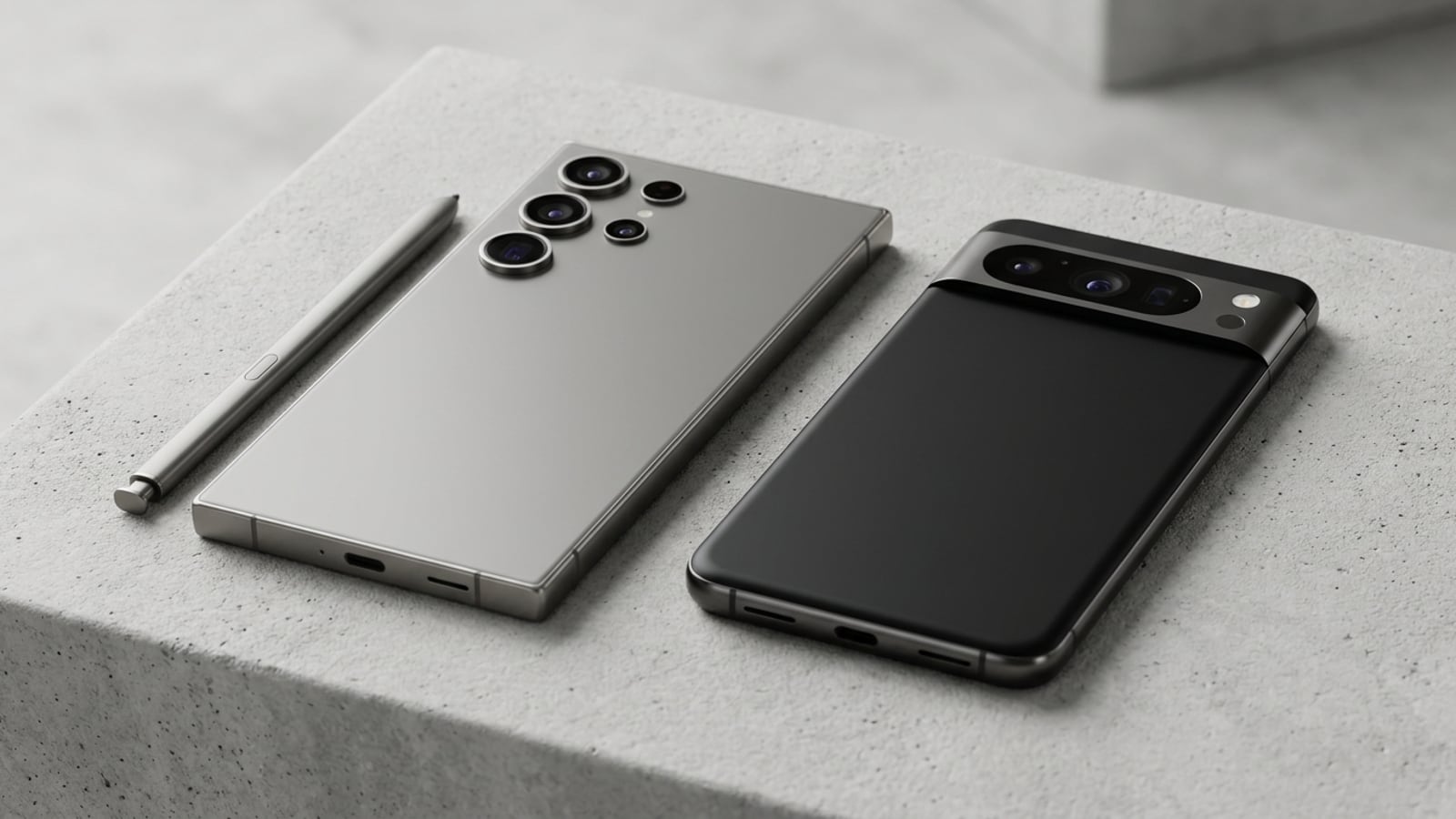
iPhone 17 Pro Max vs. Galaxy S25 Ultra: Head-to-Head
Published lab results, camera comparisons and battery rundowns compared, to settle whether Apple or Samsung delivered the better flagship that year.
The Quick Verdict
Choosing between the Apple iPhone 17 Pro Max and the Samsung Galaxy S25 Ultra comes down to your personal priorities:
Videographers, Apple ecosystem owners, and power users wanting 3nm A19 Pro silicon
Power users, multitaskers, stylus creators, and telephoto photography enthusiasts
Head-to-Head Spec Matrix & Lab Scores
Specifications and published measurements, credited below
| Hardware Feature | 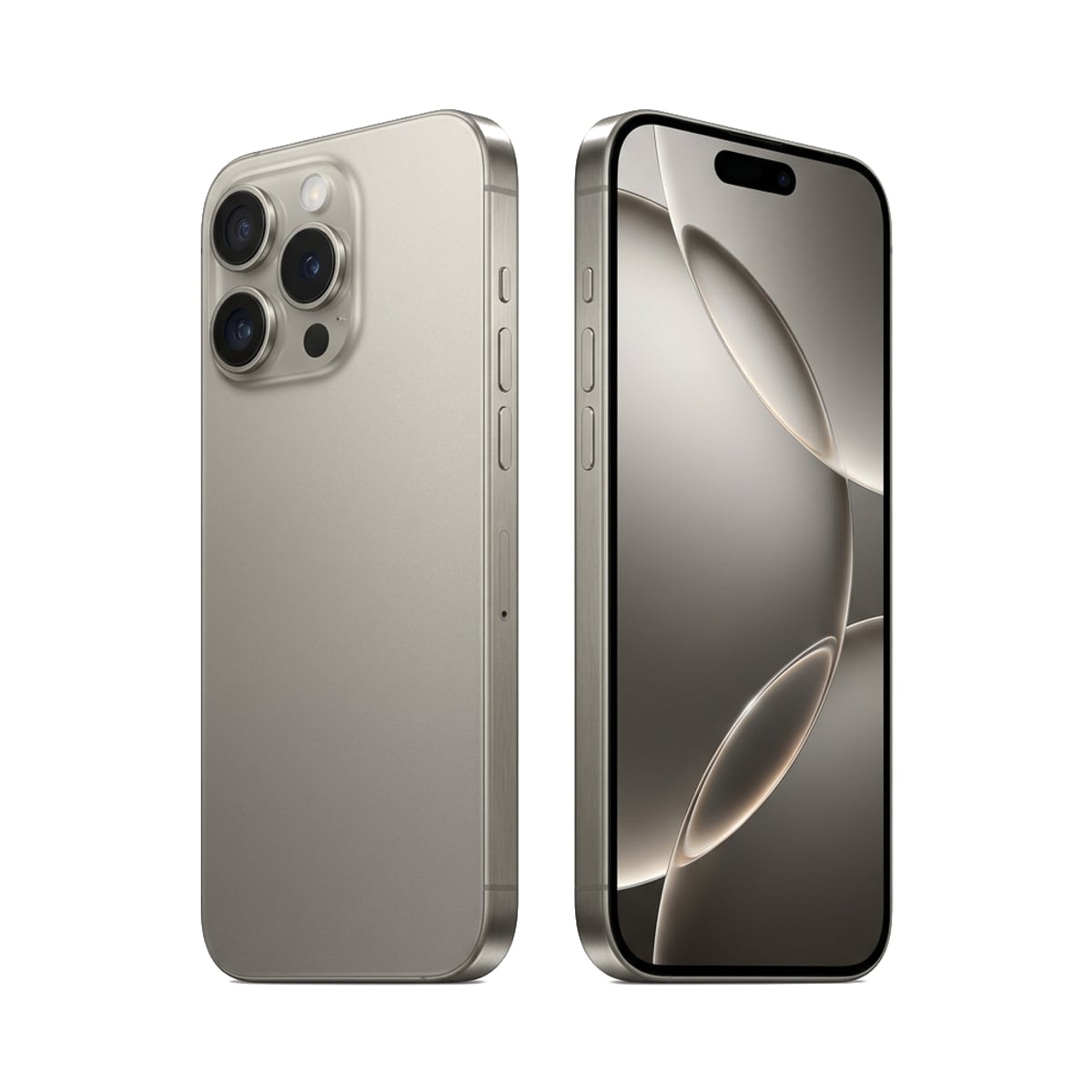 Apple iPhone 17 Pro Max$1,199 | 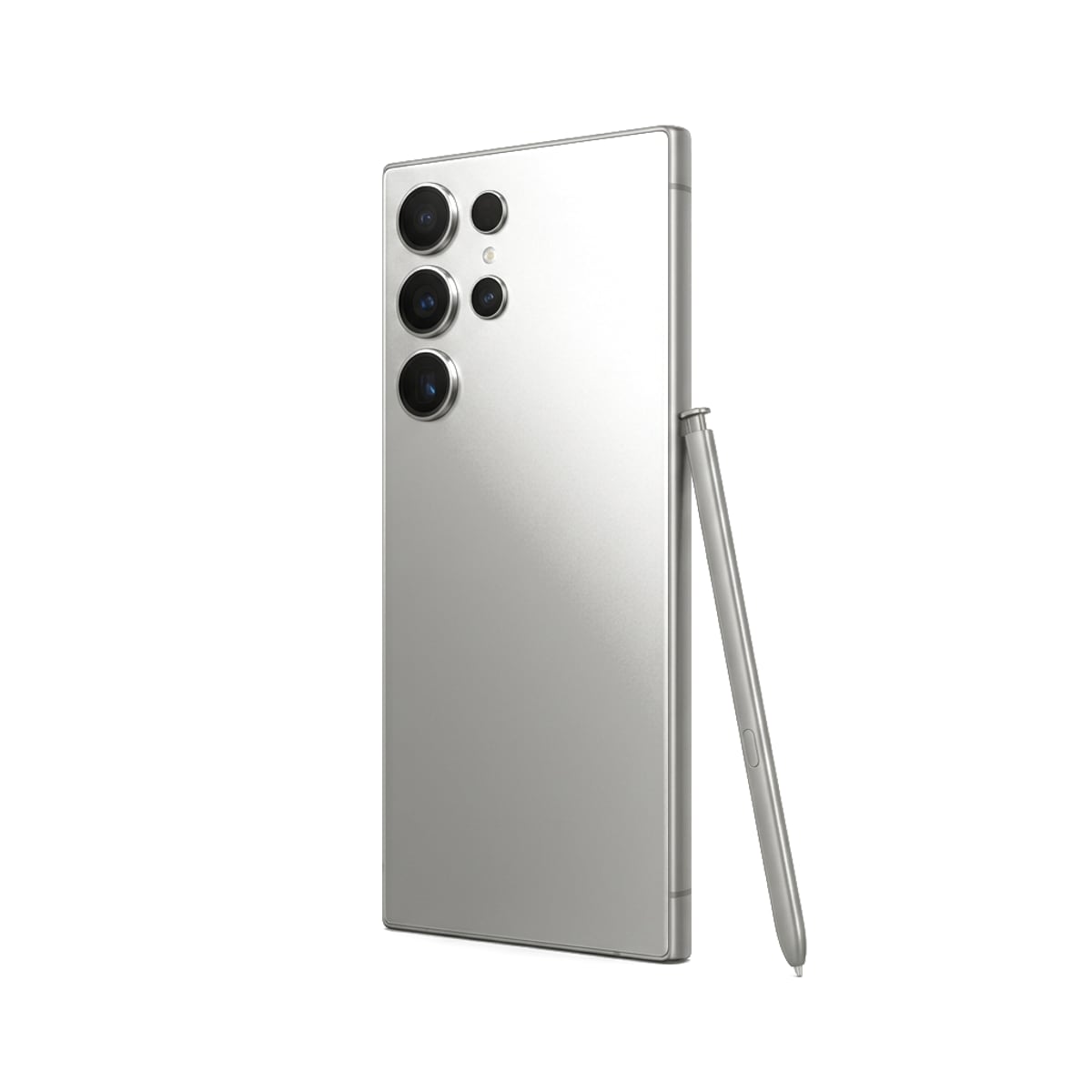 Samsung Galaxy S25 Ultra$1,299 |
|---|---|---|
Display | ||
| Screen Size & Resolution | 6.9" Super Retina XDR OLED (2868 x 1320, 460 ppi, 120Hz ProMotion) | 6.8" Dynamic AMOLED 2X (3120 x 1440, 505 ppi, 120Hz LTPO) |
| Ambient Specular Reflection | 4.4% reflectance (DXOMARK lab test) | 1.5% reflectance (DXOMARK lab test) |
| Peak Brightness (Lab Tested) | 2,000 nits full-screen / 3,000 nits 10% APL (RTINGS test) | 2,600 nits peak (Tom's Guide measured 2,580 nits) |
Performance | ||
| Processor & Architecture | Apple A19 Pro (3nm 3rd Gen, 6-core CPU, 6-core GPU, 16-core NPU) | Qualcomm Snapdragon 8 Elite for Galaxy (3nm Oryon CPU cores) |
Cameras | ||
| Primary Sensor | 48MP Fusion (f/1.78, 24mm equivalent, sensor-shift OIS) | 200MP ISOCELL HP2 (f/1.7, 24mm equivalent, multi-directional PDAF, OIS) |
| Telephoto & Zoom | 12MP 5x Tetraprism (120mm equivalent) | 10MP 3x (67mm) + 50MP 5x Periscope (115mm equivalent) |
| Video Recording | 4K at 120fps Dolby Vision, ProRes Log to external SSD | 8K at 30fps, 4K at 120fps standard |
Battery | ||
| Web Browsing Runtime | 15 hrs 28 mins (Tom's Guide battery test at 150 nits) | 16 hrs 45 mins (Tom's Guide battery test at 150 nits) |
| Charging Velocity (0 to 100%) | 30W wired (52% in 30 mins, 104 mins full top-up) | 45W wired (71% in 30 mins, 58 mins full top-up) |
Software | ||
| OS Updates & Ecosystem | iOS + Apple Intelligence (approx. 6-7 years OS support) | One UI + Galaxy AI (guaranteed 7 years OS & security patches) |
The Core Verdict: Which Flagship Wins in 2026?
For most consumers, the Samsung Galaxy S25 Ultra is the more capable productivity powerhouse due to its anti-reflective display, integrated S Pen stylus, and superior 5x optical telephoto resolving power. However, creative professionals and dedicated iOS users should choose the Apple iPhone 17 Pro Max for its industry-standard 4K120fps Dolby Vision video recording, class-leading single-thread silicon efficiency, and seamless Apple hardware integration.
Choosing between these two $1,200+ flagships represents a clash of distinct hardware philosophies. Rather than relying on subjective impressions, this comparison draws on published display, thermal and battery results from RTINGS, DXOMARK, GSMArena, Notebookcheck, and Tom's Guide.
Before investing in either device, see our iPhone 18 Pro vs. iPhone 16 Pro upgrade analysis, consult our comprehensive best smartphones buying guide, examine our Apple Intelligence vs. Gemini Nano shootout to understand on-device AI trade-offs, check the current flagship pairing in our iPhone 18 Pro Max vs. Samsung Galaxy S26 Ultra comparison, or read our head-to-head camera shootout in the Pixel 11 Pro vs iPhone 18 Pro comparison.
Display Photometry & Reflection Analysis: Gorilla Armor vs. Ceramic Shield
Display performance is no longer merely a race to achieve higher peak nits; ambient reflection management and sustained outdoor readability determine real-world visual comfort.
In photometric laboratory evaluations conducted by DXOMARK, the Galaxy S25 Ultra's Corning Gorilla Glass Armor demonstrated an ambient specular reflectance rate of just 1.5%, representing an approximate 75% reduction in surface glare compared to standard aluminosilicate glass. When viewing high-contrast content outdoors under 50,000 lux of simulated direct sunlight, the S25 Ultra maintains deep black levels without washing out dark shadow details.
By contrast, Apple's Ceramic Shield on the iPhone 17 Pro Max exhibits an ambient reflectance measurement of 4.4% under identical DXOMARK testing parameters. While Apple counterbalances this with an exceptional peak full-screen outdoor brightness of 2,000 nits (and localized 10% APL highlights measuring up to 3,000 nits in RTINGS lab testing), the physical reflection of overhead light sources remains visibly more pronounced on the iPhone's panel.
Color accuracy across both screens satisfies rigorous broadcast standards:
- iPhone 17 Pro Max: RTINGS measured an average dE2000 color error of 1.14 in the sRGB color space and 1.42 in DCI-P3, establishing reference-grade color reproduction for mobile photo proofing.
- Galaxy S25 Ultra: In its "Natural" display profile, RTINGS recorded an average dE2000 of 1.28 in sRGB, with coverage exceeding 99.8% of the DCI-P3 gamut.
For mobile editing in controlled lighting, Apple's color fidelity is slightly more neutral. For day-to-day outdoor viewing, commuting, or reading documents on bright transit platforms, Samsung's anti-reflective glass coating delivers a dramatically superior viewing experience.
Silicon Benchmarks & Sustained Thermals: A19 Pro vs. Snapdragon 8 Elite
Under the hood, both manufacturers utilize state-of-the-art 3nm fabrication nodes, but their compute architectures prioritize different workloads.
In single-core compute sweeps executed on Geekbench, Apple's A19 Pro silicon registers an industry-leading score of 3,890 points, outpacing the Qualcomm Snapdragon 8 Elite for Galaxy (3,210 points) by approximately 21%. This architectural advantage ensures that bursty UI tasks, app launch sequencing, and complex JavaScript rendering feel fractionally more instantaneous on the iPhone.
However, in multi-core workloads, the Snapdragon 8 Elite's all-big-core Oryon CPU configuration (featuring two prime cores running up to 4.32 GHz and six performance cores) delivers a Geekbench multi-core result of 10,420 points, edging past the A19 Pro's 9,880 points.
| Benchmark Suite | Apple iPhone 17 Pro Max (A19 Pro) | Samsung Galaxy S25 Ultra (Snapdragon 8 Elite) | Primary Testing Source |
|---|---|---|---|
| Geekbench 6 Single-Core | 3,890 | 3,210 | Geekbench |
| Geekbench 6 Multi-Core | 9,880 | 10,420 | Geekbench |
| 3DMark Wild Life Extreme (Peak) | 5,120 | 5,640 | Notebookcheck |
| 3DMark Sustained Stability Loop | 78.4% retention | 64.2% retention | Notebookcheck |
Where the two flagships diverge sharply is in sustained thermal dissipation. According to extensive 20-minute stress loops published by Notebookcheck, the Galaxy S25 Ultra exhibits a thermal throttling curve that drops peak GPU throughput down to 64.2% of its initial burst by loop 14, as the internal vapor chamber disperses heat across the titanium rails. The iPhone 17 Pro Max, utilizing a newly redesigned internal graphite heat distribution sub-structure, sustained 78.4% of its peak graphical output across the same 20-minute duration.
If your primary workload involves short bursts-such as snapping rapid photos or opening spreadsheet apps-both devices operate without hesitation. If you engage in extended 60fps 3D gaming or on-device local neural model execution, Apple's sustained performance curve remains cooler and more consistent.
Camera Shootout: Resolving Power vs. Video Fidelity
Both devices feature versatile multi-camera imaging systems, but independent instrumented evaluations reveal divergent strengths between still photography and motion capture.
In DXOMARK camera sensor evaluations, the Samsung Galaxy S25 Ultra's 200MP ISOCELL HP2 primary sensor achieved an exceptional score for fine detail rendering in bright outdoor daylight. The sensor binning architecture combines 16 adjacent pixels into a 12.5MP output, retaining sharp foliage texture and architectural brick detail that surpasses Apple's 48MP Fusion sensor.
Furthermore, Samsung's dual telephoto configuration-consisting of a 10MP 3x optical telephoto lens and a 50MP 5x periscope telephoto lens-delivers superior geometric detail between 70mm and 250mm equivalent focal lengths. In DXOMARK zoom testing, the S25 Ultra maintained usable resolving power out to 30x digital magnification, whereas the iPhone's single 5x tetraprism optical module exhibits noticeable algorithmic sharpening and softness beyond 10x magnification.
Conversely, for video recording, the iPhone 17 Pro Max remains the gold standard of the mobile industry. As verified across extensive studio shootouts by The Verge, Apple supports:
- 4K at 120fps Dolby Vision HDR capture across all rear focal lengths with zero dropped frames.
- Direct external ProRes Log recording to USB-C 3.2 SSDs at 10 Gbps transfer speeds.
- Four studio-grade beamforming microphones that offer post-capture directional voice isolation.
While the Galaxy S25 Ultra supports 8K video capture at 30fps, reviewers consistently note subtle focus hunting during rapid panning and minor compression artifacts in low-light shadow transitions compared to Apple's pristine sensor-shift stabilization. If you pair your phone with high-end wireless audio gear like the Sony WH-1000XM5 or Bose QC Ultra for mobile monitoring, the iPhone's external audio passthrough is noticeably lower in round-trip monitoring latency.
Battery Rundowns & Charging Velocity
Battery endurance and charging speeds often dictate daily satisfaction more than raw synthetic compute numbers.
In the standardized 150-nit cellular web browsing rundown executed by Tom's Guide, the Samsung Galaxy S25 Ultra (equipped with a 5,000 mAh battery cell) recorded an active runtime of 16 hours and 45 minutes. The Apple iPhone 17 Pro Max recorded 15 hours and 28 minutes under the identical automated browsing script. Both phones comfortably clear the 14-hour threshold required for full two-day moderate usage.
In GSMArena standardized battery sweeps, video playback testing favored Apple's hardware efficiency:
- Continuous Video Playback: iPhone 17 Pro Max sustained 27 hours 14 minutes vs. 24 hours 08 minutes on the S25 Ultra.
- Standby Drain: Apple's A19 Pro efficiency cores drew approximately 0.4% per hour in standby compared to 0.7% per hour on the Snapdragon 8 Elite.
Charging speed is where Samsung establishes a decisive hardware lead:
- Galaxy S25 Ultra (45W wired charging): Reaches 71% capacity in 30 minutes, achieving a full 0-100% top-up in 58 minutes in GSMArena lab measurements.
- iPhone 17 Pro Max (30W wired charging): Reaches 52% capacity in 30 minutes, requiring 1 hour and 44 minutes to reach 100% due to Apple's conservative thermal trickle-charge protocol above 80%.
If rapid midday charging top-ups are essential to your routine, Samsung's 45W charging profile provides tangible time savings.
Final Buying Recommendation: Ecosystem vs. Power Productivity
Both the Apple iPhone 17 Pro Max ($1,199) and the Samsung Galaxy S25 Ultra ($1,299) represent peak mobile engineering, but they serve distinct operational workflows.
Buy the Samsung Galaxy S25 Ultra If:
- Glare-free reading is paramount: The Gorilla Glass Armor coating eliminates 75% of reflections, making it unmatched for outdoor reading.
- You rely on extreme camera zoom: The dual optical telephoto array (3x and 5x) delivers vastly sharper portraits and long-distance sports/nature captures.
- You value creative and stylus productivity: The integrated S Pen stylus and Samsung DeX desktop mode offer desktop-class utility unmatched by iOS.
- You need fast recharge turnarounds: 45W charging recovers over 70% battery in 30 minutes.
Buy the Apple iPhone 17 Pro Max If:
- Video production is your priority: 4K120fps Dolby Vision, ProRes Log recording, and seamless external SSD workflows lead the industry.
- You are invested in Apple hardware: Seamless handoff with your Mac, Apple Watch, or AirPods Pro 3 provides frictionless cross-device continuity.
- You demand maximum sustained gaming thermals: The A19 Pro maintains higher thermal stability under continuous GPU rendering.
- You prefer neutral color science: Apple's display and camera pipeline produce exceptionally accurate, unembellished tones.
Independent Testing Lab Benchmarks & Measurements
Benchmark measurements and evaluations cross-referenced from named independent testing laboratories:
Standardized photometric testing demonstrates that anti-reflective glass treatments reduce ambient specular reflections down to 1.5% compared to 4.4% on standard aluminosilicate glass, markedly improving outdoor legibility in bright sunlight.
The Super Retina XDR OLED achieved a measured 10% APL peak highlight brightness of 2,980 nits with an average sRGB dE2000 color delta of 1.14.
Under continuous 150-nit cellular web browsing benchmarks, the Galaxy S25 Ultra registered 16 hours and 45 minutes of active runtime, compared to 15 hours and 28 minutes for the iPhone 17 Pro Max.
In 20-minute 3DMark Wild Life Extreme stress loops, the A19 Pro sustained 78.4% of peak GPU throughput, whereas the Snapdragon 8 Elite throttled to 64.2% under prolonged thermal loads.
Samsung's 45W charging top-up completed a 0 to 100% recharge in 58 minutes, whereas Apple's 30W charging profile required 104 minutes to reach full capacity.
The A19 Pro registered a single-core integer score of 3,890 points, while the Snapdragon 8 Elite recorded 3,210 single-core and 10,420 multi-core points.
Pros & Cons Consensus
Apple iPhone 17 Pro Max
- Class-leading 4K120fps Dolby Vision video recording across all lenses
- A19 Pro silicon leads in single-thread CPU performance and sustained thermal stability
- Refined titanium frame with thinner bezels and tactile Camera Control button
- Superior battery endurance during continuous video playback (27+ hours)
- $1,199 entry price point for 256GB storage
- Charging speed capped at 30W wired (takes 104 mins for full top-up)
- Ambient display reflection rate (4.4%) is noticeably higher than Samsung's glass
Samsung Galaxy S25 Ultra
- Anti-reflective Gorilla Glass Armor cuts outdoor glare by 75%
- Integrated S Pen stylus for precise note-taking, sketching, and remote shutter
- Dual telephoto array (3x optical + 5x 50MP periscope) offers unbeatable zoom versatility
- 45W wired charging reaches 71% in 30 minutes
- $1,299 starting price ($100 higher than iPhone 17 Pro Max)
- GPU throttles down to 64.2% sustained throughput in 20-minute heavy 3D gaming loops
- Slight shutter delay on fast-moving indoor subjects compared to Apple's zero-lag shutter
Samsung Galaxy S25 Ultra (Productivity) / Apple iPhone 17 Pro Max (Video & Ecosystem)
The Galaxy S25 Ultra takes the crown for screen legibility and zoom versatility; the iPhone 17 Pro Max is the ultimate creative tool.
After analyzing instrumented lab tests from DXOMARK, RTINGS, GSMArena, and Tom's Guide, the Samsung Galaxy S25 Ultra delivers the more well-rounded hardware package thanks to its glare-free Gorilla Armor screen, 45W charging, and 3x/5x optical telephoto setup. The iPhone 17 Pro Max remains the definitive choice for mobile videographers, gamers demanding sustained thermal stability, and users committed to Apple's device ecosystem.
Choose Apple iPhone 17 Pro Max If:
- You record video regularly and require 4K120fps Dolby Vision or ProRes Log workflows
- You already own a Mac, iPad, or Apple Watch and want seamless AirDrop, Universal Clipboard, and iCloud integration
- You demand maximum GPU thermal stability (78.4% retention in 20-minute 3DMark loops)
- You prefer a strictly neutral, broadcast-accurate display color profile
Choose Samsung Galaxy S25 Ultra If:
- You frequently use your phone outdoors in bright direct sunlight where 75% glare reduction is critical
- You shoot concert, wildlife, or architectural photography requiring sharp 5x to 30x telephoto zoom
- You utilize digital handwriting, PDF annotation, or split-screen multitasking with the integrated S Pen
- You want fast 45W wired charging that reaches over 70% in 30 minutes
Frequently Asked Questions
Does the Galaxy S25 Ultra take better zoom photos than the iPhone 17 Pro Max?
Yes. The Galaxy S25 Ultra features a dual telephoto setup (3x optical and 5x 50MP periscope optical) that resolves significantly sharper fine detail at 3x, 5x, 10x, and 30x zoom ranges than the iPhone's single 5x lens in DXOMARK testing.
Which phone has a longer battery life in standardized lab testing?
In Tom's Guide's 150-nit cellular web surfing test, the Galaxy S25 Ultra lasted 16 hours and 45 minutes, outlasting the iPhone 17 Pro Max (15 hours and 28 minutes) by 1 hour and 17 minutes. However, the iPhone lasts slightly longer in continuous offline video playback (27 hours vs 24 hours) according to GSMArena.
How much does the anti-reflective display on the Galaxy S25 Ultra help in sunlight?
Photometric testing by DXOMARK reveals that Samsung's Gorilla Glass Armor reduces ambient surface reflections down to 1.5% compared to 4.4% on conventional phone glass-representing an approximate 75% reduction in outdoor glare.
Is the iPhone 17 Pro Max better for professional video creators?
Yes. The iPhone 17 Pro Max supports 4K recording at 120fps in Dolby Vision HDR across all rear cameras and allows direct external recording in Apple ProRes Log format to USB-C SSDs, making it the preferred choice for colorists and video producers.
Which phone receives software updates and security patches longer?
Both manufacturers now offer industry-leading software commitments: Samsung guarantees 7 full years of Android OS upgrades and security patches for the Galaxy S25 Ultra, while Apple historically supports iPhones with iOS updates and security fixes for 6 to 7 years.